Overview
A Steam Deck motherboard is the whole computer: four Zen 2 cores, a capable little RDNA2 GPU, and 16GB of fast LPDDR5, all on one board. Boards from broken decks sell cheap on the salvage market, often for less than the RAM alone would cost, because without a screen, case, or battery most buyers have no use for them.
This project gives them a use. Each board becomes an always-on node in a small local-LLM cluster: ethernet and USB-C power in, an OpenAI-compatible API out. The full setup is open source on GitHub, and the build has a video on my FloralOvercast YouTube channel.
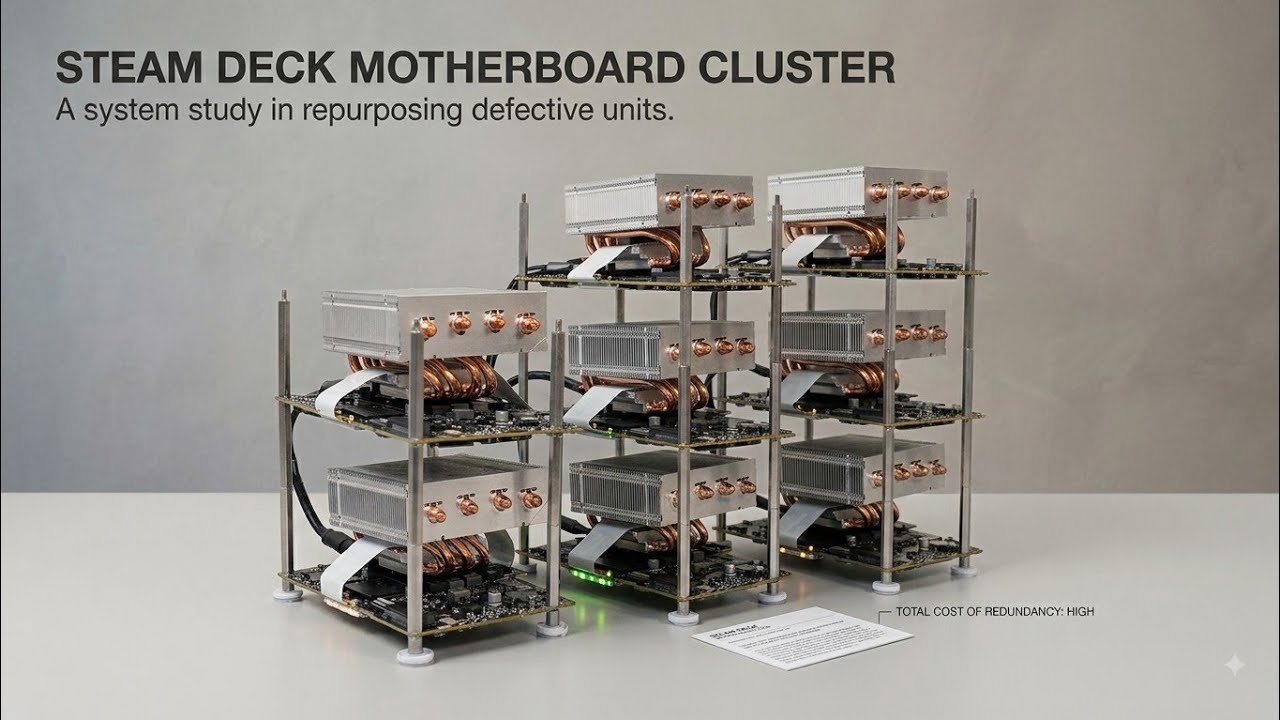
The trick: no storage at all
The boards have no disk, and never need one. Each one network-boots (PXE) into Fedora CoreOS running entirely in RAM, applies a single declarative config, mounts the shared model library read-only over NFS, and starts serving. Pull the power and it leaves no trace; plug it back in and it rebuilds itself in about two minutes, zero-touch.
There is no per-board setup. Every board boots the same image, learns its identity from the network, and picks its model from one shared assignment file. Swapping a board's model is one edited line and a service restart. A board dying, appearing, or being unplugged mid-run is a non-event, which is exactly the right property for salvage hardware.
The firmware fights back
- GPU clock pin: Out of the box the firmware throttles a bare board's GPU hard. A small service pins the clock at boot; without it, inference crawls at under 2 tokens/sec. With it, an 8B model holds ~12 tokens/sec per board on my units, and the boards together sustain roughly 60 tokens/sec.
- Fitting an 8B model: The BIOS only carves 1GB for the GPU, but a kernel argument extends usable graphics memory into system RAM, which is what lets an 8B model run fully on the GPU.
- Cooling bare boards: No case means no airflow design. After testing coolers against a hard 90°C kill rule, the answer was phase-change thermal sheets, plain aluminum bars bridging boards, and one big fan: the whole shelf peaks in the mid-50s°C under full load.
Why it might matter to you
The interesting part is not Steam Decks specifically. It is that any cheap board with decent memory and an integrated GPU can be a disposable, disk-free inference node, and the pattern (PXE into RAM, declarative config, models over NFS, pin the clocks) transfers. The repo documents the whole chain, including the parts that did not work, so someone else can do this with one board and a home router.